

🎧 Listen to the Podcast: Is Your Houston Business Really Secure?
Prefer listening over reading? Explore the essential cybersecurity risks facing Houston businesses in this conversational audio discussion.
Discover why antivirus protection isn’t enough, what professional cybersecurity assessments reveal, and how business owners can take practical steps to protect their operations.
Presented by SpaceCenter Systems
*
*
An AI-generated podcast discussion based on our cybersecurity guide.
notebooklm.link.google/0Z2WrZnhAer6
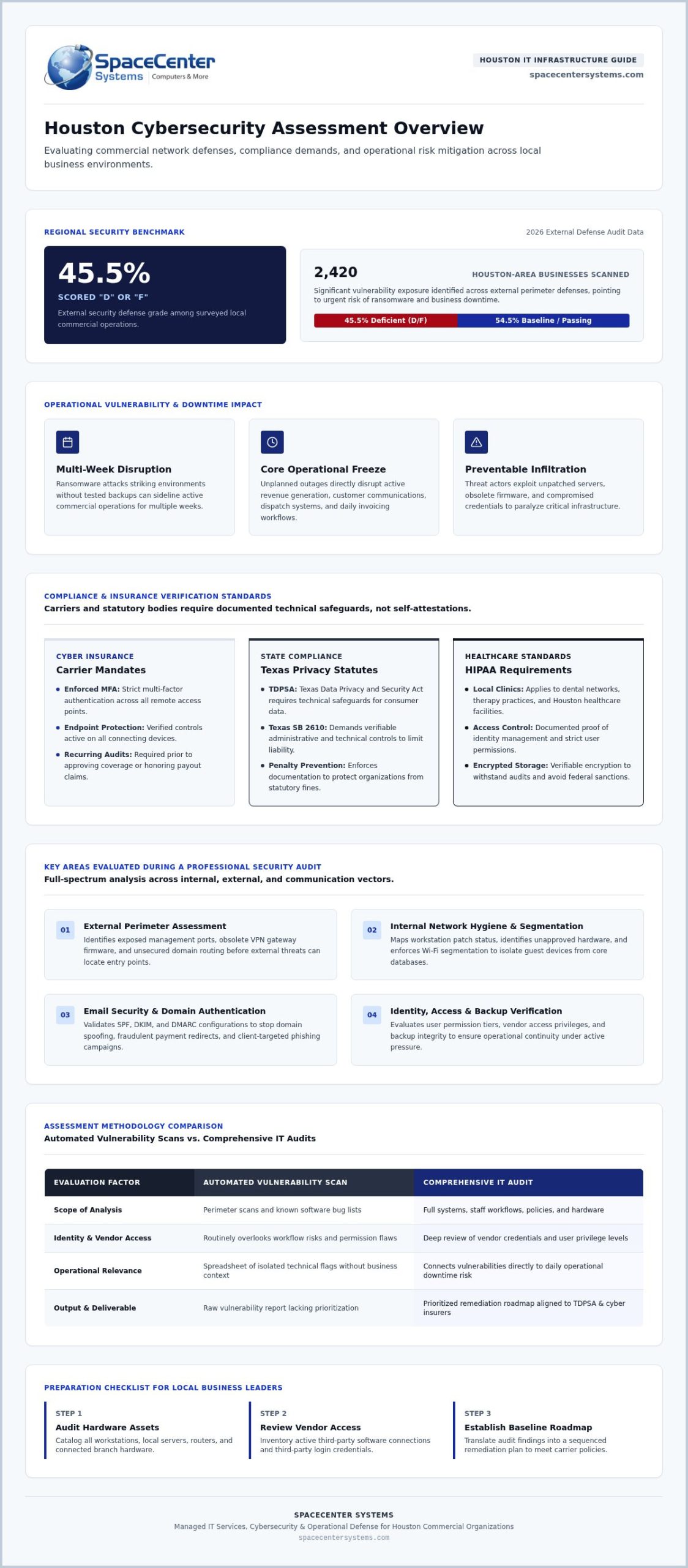
A 2026 security scan of 2,420 Houston-area businesses revealed that 45.5% scored a "D" or "F" on external security defenses. If you lead a local commercial operation or healthcare practice, scheduling a professional cybersecurity assessment Houston organizations can depend on is no longer a routine IT chore. It’s an essential defense against crippling ransomware downtime and costly operational disruptions.
You likely already feel the pressure of confusing technical jargon, strict cyber insurance questionnaires, and rigorous Texas privacy regulations like the TDPSA. You shouldn’t have to guess whether your existing network controls will hold up during an audit or an attack. In this guide, you will discover how a comprehensive cybersecurity assessment protects your Houston business from costly downtime, data breaches, and compliance penalties. We’ll walk through what actually happens during a thorough technical evaluation, explain how to verify your cyber insurance readiness, and show you how to turn vulnerabilities into a prioritized, actionable remediation roadmap.
Key Takeaways
- Understand the core components of a comprehensive cybersecurity assessment Houston businesses need to uncover hidden vulnerabilities before attackers do.
- Discover why human-led IT evaluations expose critical operational gaps, workflow risks, and identity flaws that automated scans routinely overlook.
- Learn simple, practical steps to audit your hardware, third-party software, and vendor access permissions before scheduling a technical review.
- Explore how to transform raw assessment findings into a prioritized remediation plan that satisfies strict cyber insurance and Texas privacy mandates.
What Is a Cybersecurity Assessment for Houston Businesses?
A cybersecurity assessment is a structured evaluation of your company’s digital systems, operating policies, and physical safeguards. Rather than relying on abstract checklists or theoretical formulas, it maps directly to how your staff works each day. For commercial firms across our region, investing in a professional cybersecurity assessment Houston companies rely on means identifying exploitable gaps across firewalls, user permissions, and email routing before external threats take hold. Local organizations face persistent phishing campaigns, credential theft, and business email compromise on a regular basis. You can partner with dedicated Houston IT services to protect your local commercial infrastructure and ensure your operational technology remains dependable.
A formal review functions much like an Information Security Audit, establishing an objective baseline for your entire digital environment. This process connects technical vulnerabilities directly to operational risk. Instead of presenting business leaders with confusing spreadsheets full of isolated software bugs, a thorough review reveals how an unpatched server or misconfigured router could halt daily operations. It gives leadership the clarity needed to make practical, cost-effective decisions that protect long-term business continuity.
The Real Cost of Operational Downtime in Houston
Unplanned outages immediately disrupt revenue, customer communications, dispatch systems, and invoicing. When a local company experiences a ransomware attack without tested backups, recovery can sideline active operations for multiple weeks. A focused cybersecurity assessment Houston providers conduct uncovers hidden network misconfigurations, obsolete firmware, and compromised credentials before attackers exploit those weaknesses to freeze core functions.
Regulatory Compliance and Cyber Insurance Demands
Securing affordable commercial cyber insurance now requires strict technical accountability across every department. Underwriters no longer issue policies based solely on self-attestation forms. Instead, they require documented evidence of basic safeguards:
- Carrier Requirements: Insurers mandate enforced multi-factor authentication (MFA) across remote access points, verified endpoint protection, and recurring security audits before approving coverage or honoring payout claims.
- Texas Privacy Laws: The Texas Data Privacy and Security Act (TDPSA) and Texas SB 2610 require businesses handling sensitive consumer information to maintain reasonable administrative and technical controls to limit liability.
- HIPAA Standards: Houston healthcare clinics, dental networks, and therapy practices must prove strict access control and encrypted data storage to withstand federal audits and avoid costly penalties.
Key Areas Evaluated During a Professional Security Audit
A rigorous security review examines every layer of your company’s operating environment. Rather than stopping at perimeter firewalls, certified engineers evaluate how data travels across your local infrastructure, where sensitive records reside, and how employees interact with everyday applications. A complete cybersecurity assessment Houston businesses conduct balances software vulnerabilities with real-world business continuity, ensuring your organization can maintain normal operations even under direct pressure.
After an initial baseline evaluation, many companies rely on ongoing managed IT services to maintain these rigorous standards and prevent configuration drift over time. This ongoing oversight keeps local networks aligned with carrier demands and operational best practices.
External Perimeter and Internal Network Hygiene
Auditors begin by scanning external facing assets to locate exposed management ports, obsolete VPN gateway firmware, and unsecured domain routing. Internally, technicians map workstation patch status, locate unapproved hardware, and evaluate wireless network segmentation. Separating corporate workstations from guest Wi-Fi networks prevents unmanaged personal smartphones and visitor tablets from spreading malware into core operational databases.
Email Security and Phishing Susceptibility
Because malicious messages remain a primary gateway for network breaches, assessing communication channels is critical. A detailed review covers several core safeguards:
- Domain Authentication: Engineers inspect SPF, DKIM, and DMARC configurations to confirm your domain cannot be forged to execute financial fraud or spoof clients.
- Inbox Filtering: Technical filters undergo testing to verify they intercept zero-day links, malicious macros, and credential-harvesting pages before reaching employees.
- Employee Readiness: Staff phishing susceptibility simulations measure how well team members identify deceptive emails, establishing where targeted security awareness training will yield immediate risk reduction.
Physical Security and Environmental Safeguards
Digital defenses fail if physical equipment remains unprotected. During an onsite evaluation, engineers inspect server closets to verify lock integrity and review whether keycard systems restrict server access to authorized personnel. They also examine facility camera angles to confirm coverage of network racks and entrances. Finally, technicians inspect battery backup units and power conditioning systems, ensuring that sudden Gulf Coast power surges won’t corrupt storage drives or bring down mission-critical communication channels.
If you’re unsure whether your physical racks, backup systems, or perimeter firewalls meet modern criteria, consider working with an experienced team for network security support to eliminate lingering blind spots across your business.
Automated Vulnerability Scans vs. Comprehensive IT Audits
Many business leaders confuse running an automated network scan with completing a true security audit. While automated vulnerability tools sweep IP ranges quickly, they often produce dense, fifty-page reports filled with noisy data, false positives, and unranked warnings. A complete cybersecurity assessment Houston firms trust combines these programmatic discovery tools with hands-on engineering analysis. By interpreting technical findings through the lens of your actual business workflows, a professional team can separate harmless anomalies from high-priority threats.
Pairing periodic audits with ongoing network security ensures continuous protection year-round. This layered strategy prevents new configuration vulnerabilities from lingering undetected between scheduled formal reviews.
Why Automated Scanners Miss Critical Business Context
Automated software lacks operational intelligence. A scanner sees an unpatched software port, but it cannot tell whether that machine sits isolated in a closed test lab or acts as your active accounting server. This limitation creates two major operational problems for leadership:
- Alert Fatigue: Business owners and internal IT staff get overwhelmed by hundreds of flagged items, making it difficult to pinpoint which vulnerabilities pose an actual risk to company revenue.
- Missed Policy Flaws: Software scanners cannot detect weak onboarding procedures, shared administrative passwords, or sensitive customer records saved on unencrypted personal desktops.
Experienced technical specialists validate raw scan results manually. This human oversight filters out phantom alerts and highlights the precise weaknesses attackers target most frequently.
The Advantage of Local, Hands-On Engineering Review
Software cannot inspect the physical realities of your workplace. An on-site engineering team examines switch closets, traces structured cabling, and verifies that temperature controls keep critical hardware from failing during sweltering Texas summers. Direct staff conversations also uncover dangerous operational shortcuts, like staff disabling multi-factor authentication or using unsanctioned personal cloud drives to transfer sensitive client documents.
A professional cybersecurity assessment Houston organizations rely on transforms automated data into a practical, step-by-step remediation plan. Rather than handing you generic templates, local engineers design defensive controls around your daily operational needs, protecting your bottom line without slowing down your team.
How Houston Business Owners Prepare for a Security Review
Preparing for a technical evaluation doesn’t require months of complex administrative paperwork. A well-organized onboarding process respects your operational schedule and keeps your staff focused on daily responsibilities. When preparing for a professional cybersecurity assessment Houston organizations find that gathering basic structural documentation ahead of time accelerates the review and delivers faster, more accurate results.
Following a clear, five-step preparation plan sets your audit up for immediate success:
- Step 1: Inventory Physical Assets: Build an initial list of company desktops, laptops, on-premise servers, and networked printers.
- Step 2: Document Software and Cloud Tools: Catalog your cloud productivity suites, specialized line-of-business applications, and remote file shares.
- Step 3: Review Insurance Questionnaires: Gather your carrier’s current renewal forms to highlight specific controls underwriters require this policy term.
- Step 4: Designate an Internal Point of Contact: Appoint an operations manager or lead technician who can securely provide administrative credentials without operational delay.
- Step 5: Establish Assessment Windows: Coordinate evaluation schedules with your engineering team to ensure non-disruptive, after-hours testing protocols.
Schedule a consultation to begin your business security review
Compiling Device and Software Asset Inventories
An accurate hardware inventory forms the backbone of any reliable audit. Catalog all equipment tied to your local network, including wireless access points, network switches, and shared office peripherals. It’s especially important to identify older machines running unsupported operating systems, as these legacy terminals represent immediate vulnerabilities. Make sure to document hybrid staff who connect remote laptops or personal mobile devices to your corporate databases from home.
Gathering Access Credentials and Vendor Agreements
Auditors require appropriate administrative visibility to measure technical controls accurately. Compile administrative credentials for firewalls, domain controllers, and cloud environments within a secure password vault before the audit starts. In addition, review vendor agreements for third-party billing platforms, off-site logistics tools, and HVAC monitoring links. External vendors often retain broad network access long after an initial installation project finishes, leaving quiet backdoors into your core environment.
Finally, confirm that company leadership has formally approved vulnerability scanning protocols. Experienced engineers run these scans during low-traffic periods or after hours, ensuring full visibility without slowing down daily business operations.
Turning Assessment Findings into a Stronger Defense
A technical assessment delivers real business value only when you put its recommendations into practice. Too many organizations receive a complex security audit, review the executive summary once, and let the binder collect dust while dangerous network vulnerabilities persist. A well-executed cybersecurity assessment Houston organizations undergo provides a clear, practical roadmap that translates raw technical discoveries into targeted business improvements.
Closing your company’s security gaps means moving away from reactive break-fix IT habits. By implementing immediate technical safeguards alongside dependable business continuity and disaster recovery solutions, your organization builds long-term operational resilience that withstands equipment failures and external intrusions.
Creating a Realistic, Risk-Prioritized Remediation Plan
Trying to patch every minor issue on day one can overwhelm your internal staff and strain resources. A pragmatic remediation roadmap ranks discovered vulnerabilities by active exploit likelihood and operational impact:
- Phase 1 (Immediate Fixes): Resolve critical flaws within 48 to 72 hours, focusing on exposed gateway ports, overdue operating system security patches, and mandatory multi-factor authentication enforcement.
- Phase 2 (Configuration Hardening): Update firewall policies, eliminate obsolete administrative accounts, and segment guest wireless access over the following 30 days.
- Phase 3 (Strategic Upgrades): Plan long-term hardware refreshes, structured cabling replacements, and backup storage expansions to align neatly with your annual IT operating budget.
Establishing Continuous Monitoring and Incident Response
A point-in-time review records network health at a specific moment, but modern cyber threats adapt constantly. Real-time network monitoring and system health dashboards keep certified technicians alerted to unauthorized access attempts, sudden bandwidth spikes, or dormant devices reconnecting unexpectedly. In addition, scheduling routine disaster recovery simulations confirms that off-site backups restore cleanly when equipment fails or weather strikes.
Partnering with SpaceCenter Systems for Local Support
Since 1995, SpaceCenter Systems has delivered dependable, hands-on technology solutions to commercial operations, clinics, and professional practices across Greater Houston and Pearland. We bridge the gap between digital defense and physical infrastructure, combining IT consulting, network monitoring, and commercial access control under one roof. When you need clear answers without confusing jargon, our local engineering team is ready to help you protect your business continuity. Take the next step today and schedule a consultation with our technical team to establish your baseline defense.
Secure Your Houston Operations with Confident Technical Oversight
Protecting your company against prolonged downtime and costly data breaches starts with an honest evaluation of your current network defenses. By investing in a comprehensive cybersecurity assessment Houston businesses gain immediate visibility into hidden vulnerabilities, fulfill stringent cyber insurance prerequisites, and establish a clear path toward state and federal regulatory compliance.
SpaceCenter Systems has served regional healthcare offices, commercial facilities, and property management firms across Greater Houston and Pearland since 1995. With over 25 years of local business technology experience, our engineering team unifies managed IT, ongoing network monitoring, and physical access control to safeguard your entire operational footprint. You don’t have to navigate evolving cyber risks or confusing compliance mandates on your own.
Schedule a comprehensive cybersecurity consultation with SpaceCenter Systems
Take control of your digital infrastructure today and give your business the dependable security foundation it deserves.
Frequently Asked Questions
How much does a typical cybersecurity assessment disrupt daily business operations?
A standard assessment causes virtually no disruption to your daily workflow. Experienced engineers run network scans during off-peak hours or scheduled maintenance windows. Staff interviews and administrative reviews are scheduled around your team’s availability, allowing daily business communication, billing, and customer operations across your office to continue without system reboots or unplanned downtime.
How long does a thorough cybersecurity assessment take to complete?
Most commercial evaluations take between one to three weeks from kickoff to final presentation. The physical walkthrough and data collection phases typically wrap up within a few days. The remaining time allows engineers to manually validate automated findings, eliminate false positives, and compile a clear, risk-ranked remediation roadmap tailored to your specific organizational goals.
Will our existing antivirus software protect us without a cybersecurity assessment?
Standard antivirus software alone cannot protect modern commercial environments. Traditional endpoint tools only scan for known malware signatures on local drives. They don’t detect unpatched gateway firmware, dangerous email forwarding rules, shared administrator accounts, or vulnerable network switches. A professional cybersecurity assessment Houston organizations undergo inspects your entire operational framework, uncovering structural flaws that endpoint software completely ignores.
What happens if the assessment reveals critical security vulnerabilities on our network?
Critical vulnerabilities receive immediate emergency triage rather than waiting for the final report. If an engineer discovers active exploits, unsecured remote ports, or severe data leaks, they notify your designated leadership contact right away. You receive practical, step-by-step guidance to patch the exposed service or isolate the affected machine immediately, protecting operations while long-term fixes are planned.
Can a cybersecurity assessment help our business qualify for cyber insurance?
Yes, completing a formal assessment directly satisfies modern underwriter prerequisites. Commercial insurance carriers now require concrete proof of multi-factor authentication, verified data backups, and routine vulnerability evaluations. The detailed documentation provided after an assessment gives your insurance broker verified technical evidence, ensuring your application gets approved and claims aren’t denied during an incident.
Is an assessment necessary if our company stores all data in the cloud?
Cloud environments require just as much scrutiny as on-premise hardware. While cloud providers manage server maintenance, securing user access permissions, multi-factor authentication, and data sync settings remains your responsibility. Unmanaged laptops, compromised user passwords, or unsecured office Wi-Fi networks can easily expose cloud files, making an assessment necessary to protect your accounts.
How often should a Houston business conduct a formal cybersecurity assessment?
Commercial firms should schedule an in-depth cybersecurity assessment Houston providers conduct at least once a year. In addition, you should initiate an audit whenever you carry out an office move, complete a major network redesign, or adopt new cloud software. Routine annual assessments ensure your company keeps pace with evolving Texas data privacy regulations and new operational threats.